
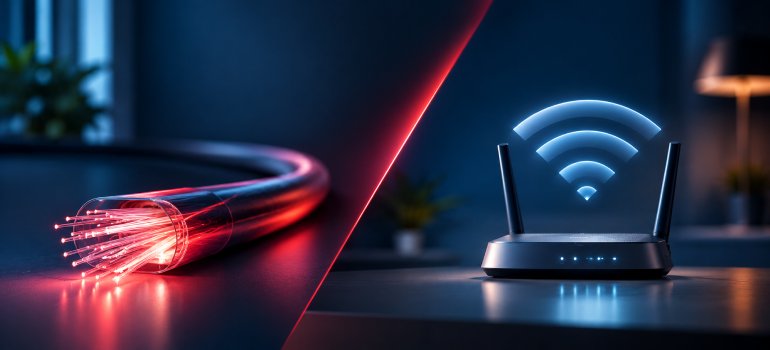
When choosing a home internet connection, you may come across two options: fiber broadband and wireless broadband. Both provide internet access for streaming, online learning, remote work, and everyday browsing, but they use different technologies to deliver connectivity.
The main difference between fiber vs wireless broadband is how data reaches your home. Fiber broadband uses optical cables to transmit data through light signals, while wireless broadband uses radio signals to establish a connection between your premises and the service provider’s network.
Understanding how these technologies work can help you choose a broadband connection based on your household’s internet requirements, location and budget.
What Is Fiber Broadband?
Fiber broadband is an internet connection that transmits data through thin strands of optical fiber using pulses of light.
In a Fiber to the Home (FTTH) connection, optical fiber extends directly to the subscriber’s premises. An Optical Network Terminal (ONT) converts optical signals into data that can be distributed to connected devices through a router.
Fiber technology supports high data transmission capacity, making it suitable for households with multiple users and bandwidth-intensive internet activities.
Advantages of Fiber Broadband
- High-speed potential: Fiber networks can support substantial download and upload capacity.
- Consistent connectivity: Optical transmission is less susceptible to radio interference affecting wireless access links.
- Low latency potential: Fiber connections can support responsive internet activities such as online gaming and video conferencing.
- Multiple device usage: A suitable fiber broadband plan can accommodate several simultaneous internet activities.
- Long-term capacity: Fiber infrastructure can support increasing bandwidth requirements through compatible network upgrades.
Limitations of Fiber Broadband
Fiber broadband requires physical infrastructure to reach the subscriber’s premises.
Availability depends on the service provider’s network coverage. Installation may also involve cable routing, building permissions, and suitable networking equipment.
Actual performance depends on the subscribed plan, network conditions, and equipment capabilities.
What Is Wireless Broadband?
Wireless broadband delivers internet connectivity through radio signals rather than a physical cable for the final connection to the subscriber’s premises.
For home internet, this commonly takes the form of Fixed Wireless Access (FWA).
Fixed wireless broadband uses a receiver or compatible networking device to communicate with a nearby tower or access point. The connection is then distributed to devices within the home.
Some fixed wireless services use 4G or 5G cellular technology, while others use different radio communication systems.
Although the final connection is wireless, the provider may still use optical fiber elsewhere in its network.
Advantages of Wireless Broadband
- Reduced cabling requirements: A physical fiber cable may not need to be installed all the way to the premises.
- Flexible deployment: Wireless connectivity can be useful where laying cables is difficult.
- Potentially quicker installation: Setup may require less civil or cabling work, depending on the location.
- Alternative connectivity: It can provide home internet access in areas where fiber infrastructure is unavailable.
Limitations of Wireless Broadband
Wireless broadband performance can depend on signal strength, network capacity, distance from the access point, and surrounding obstacles.
Buildings, terrain, and certain weather conditions may affect some wireless connections.
Performance can also fluctuate when several subscribers share available wireless network capacity.
Fiber vs Wireless Broadband: Key Differences
The following table compares the main characteristics of fiber and fixed wireless broadband.
| Feature | Fiber Broadband | Wireless Broadband |
| Transmission medium | Optical fiber cables | Radio signals |
| Speed potential | High | Depends on wireless technology and network conditions |
| Connection stability | Generally less affected by radio interference | Can vary with signal and environmental conditions |
| Latency | Generally supports low latency | Depends on radio access and network conditions |
| Upload speed | Can support high upload capacity | Varies by technology and plan |
| Installation | Requires physical fiber connectivity | Requires suitable wireless equipment and coverage |
| Availability | Depends on fiber infrastructure | Depends on wireless network coverage |
| Weather exposure | Optical transmission is less directly affected | Certain radio links may be affected |
| Cost | Depends on the provider and plan | Depends on the provider and plan |
1. Internet Speed and Bandwidth
Fiber broadband generally offers higher long-term bandwidth potential because optical fiber can carry substantial amounts of data.
Modern wireless broadband technologies, including 5G-based fixed wireless services, can also deliver high-speed internet.
The difference becomes more relevant when several people use the connection simultaneously.
For example, a household may have someone attending a video meeting, another person streaming a movie and a third downloading a large file.
Both technologies can support these activities if sufficient bandwidth is available. Actual performance depends on the subscribed service and available network capacity.
2. Connection Stability and Reliability
Fiber transmits data through a physical optical cable, making the access link less dependent on surrounding radio signal conditions.
Wireless broadband relies on communication between a receiver and network access equipment. Signal obstruction, interference and changing network demand may influence performance.
This does not mean wireless broadband is always unreliable or that fiber connections never experience interruptions.
Equipment failures, network congestion, damaged cables and power outages can affect either type of service.
3. Latency and Gaming Performance
Latency refers to the delay involved in transmitting data between your device and a destination.
Lower and more consistent latency can improve interactive activities such as online gaming, video calls and remote desktop access.
Fiber broadband generally provides favourable conditions for low-latency connectivity.
Wireless broadband can also support these activities, although radio conditions and network traffic may introduce additional variability.
For online gaming, latency, packet loss and connection stability are often more important than download speed alone.
4. Installation and Availability
Fiber broadband requires a physical cable connection to the premises. Installation may involve routing cables through buildings or connecting to existing local infrastructure.
Fixed wireless broadband can reduce the need for last-mile cabling, although suitable receivers, mounting locations and network coverage are still required.
For households in areas without fiber infrastructure, wireless broadband may be a practical alternative.
5. Cost and Long-Term Usage
There is no universal price difference between fiber and wireless broadband.
Monthly charges, installation costs, equipment fees, data allowances and service conditions vary between providers.
Rather than comparing only monthly prices, consider the total cost and whether the available service can meet your household’s internet requirements over time.
Is Wireless Broadband the Same as Wi-Fi?
No. Wireless broadband and Wi-Fi serve different purposes.
Wireless broadband describes how an internet service provider delivers connectivity to your premises.
Wi-Fi is a local wireless networking technology that connects devices such as smartphones, laptops and smart TVs to a router or access point.
A fiber broadband connection can provide Wi-Fi throughout your home. Similarly, a fixed wireless broadband connection can distribute internet access through Wi-Fi.
Fixed wireless broadband should also be distinguished from portable mobile data services. The difference between broadband and mobile internet becomes particularly relevant when comparing permanent home connectivity with internet access while travelling.
Which Broadband Connection Is Better for Your Home?
The right connection depends on how your household uses the internet.
For Working From Home
Remote workers who frequently attend video meetings, use cloud applications and upload large documents may benefit from the consistency and upload capacity that a suitable fiber connection can provide.
Wireless broadband can also support remote work when signal quality and available bandwidth are sufficient.
For Families and Multiple Devices
Households with several smartphones, laptops, smart TVs and gaming consoles should consider the combined demand placed on their internet connection.
Fiber is generally a strong option for households with growing bandwidth requirements. Wireless broadband may also be sufficient when the available service meets peak household usage.
For Streaming and Online Gaming
Streaming requires sufficient sustained download speed, while online gaming benefits from low latency and stable connectivity.
Fiber broadband can be advantageous for households that regularly combine these activities.
For Areas Without Fiber Infrastructure
Fixed wireless broadband can be a useful alternative when a physical fiber connection is unavailable or difficult to install.
What Should You Consider Before Choosing a Connection?
Before subscribing to either service, evaluate the following factors:
- Availability at your exact address.
- Advertised download and upload speeds.
- Connection stability during peak usage hours.
- Number of simultaneous users and devices.
- Installation and equipment requirements.
- Monthly charges, data allowances and service terms.
- Customer support and maintenance arrangements.
Also consider Wi-Fi coverage within your home. A fast internet connection may still deliver poor performance in distant rooms if the router is incorrectly positioned or wireless coverage is insufficient.
Conclusion
The comparison between fiber vs wireless broadband comes down to how connectivity is delivered, how consistently the network performs and what the household requires.
Fiber broadband offers high capacity and favourable conditions for stable, low-latency connectivity. Wireless broadband provides an alternative where physical cabling is difficult or fiber infrastructure is unavailable.
Both technologies can support everyday internet activities when the available service meets the user’s requirements.
Before choosing a connection, compare actual service availability, speed, reliability, installation requirements and total cost rather than relying on the technology name alone.


