
Introduction
Having a fast and reliable internet connection is no longer a luxury in today’s digital world, it’s a mere necessity. Regardless of your needs, such as working from home, streaming videos, gaming, or attending online classes, a reliable internet connection is essential. In this context, one of the most advanced technologies that enables modern internet connectivity is FTTH (Fiber-to-the-home) connection.
But what is fiber to the home and why is it gaining traction recent days?
In this detailed guide, let us explore everything about FTTH fibre connection, including its key features, benefits, installation, and how it works.
What is an FTTH Connection?
FTTH stands for “Fibre to the Home” internet connection. This internet connection technology uses fibre optic cables to transmit high speed internet, fulfilling your requirements.
Traditional broadband connections rely on copper wires, whereas FTTH uses fiber optic cables, made up of thin strands of glass/plastic that transmit data as light signals, further allowing them to transmit data at very high speeds.
Nevertheless, an FTTH connection provides significantly more reliable performance, lower latency, and faster speeds.
To put in simple terms-
FTTH means- Internet delivered through fiber optic cables to your home or office premises.
How Does an FTTH Connection Work?
- The internet data is transmitted from the ISP’s office, where the ISP’s equipment acts as the “brain” of the network.
- The data travels through the network of fiber-optic cables.
- An Optical Network Terminal (ONT) device is installed at the user’s place, which converts optical signals into electrical signals (Ethernet).
- Finally, the Optical Network Terminal (ONT) connects to a Wi-Fi router, thereby providing internet access to all your devices.
Benefits of FTTH Connection
FTTH fiber connection stands ahead of its competitors due to its high-end capabilities. Additionally, it is replacing traditional internet connections owing to diverse beneficial features-
1. Higher Bandwidth
Several devices and users can connect to the internet simultaneously without slowing the speed.
2. Ultra-fast Speed
FTTH fiber connection provides speed ranging from 100 Mbps to 10 Gbps. Fiber optic cables carry a huge amount of data at incredible speeds, and thus buffering and lag become nonexistent.
3. Proportioned Speed
Downloading and uploading speed are equal.
4. Reliable Internet Connection
Unlike traditional broadband connections, FTTH network are tend to be less affected by climatic conditions and signal interference.
5. Lower Latency
FTTH connection is perfect for online work, classes, video calls, and gaming with minimal lag.
6. Future Proof Technology
FTTH connection is designed considering the future demand for internet connection.
FTTH Installation Process
The installation process to get an FTTH internet connection entirely depends on your specific internet service provider and your location.
Here is a general overview of the steps involved in installing an FTTH connection:
1. Determining the Feasibility of the Connection
The initial step is to determine the FTTH connection feasibility. However, this involves assessing the location of your home and checking for the availability of fiber optic cables in your location.
2. Installation Appointment
If FTTH connection is feasible in your location, the ISP will schedule an appointment to start the installation process.
3. Installing Network Interface Device (NID)
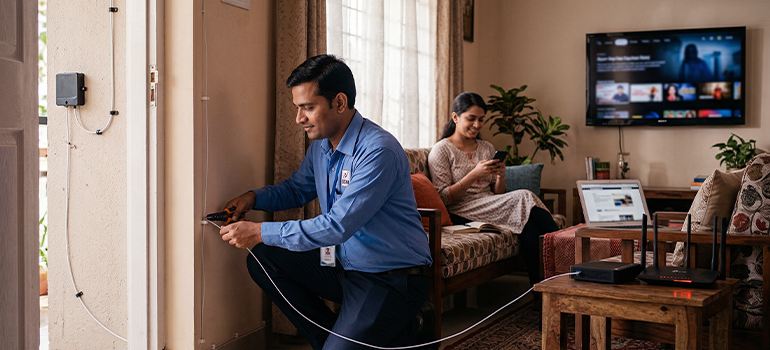
The technician will start the installation process by installing an NID outside your home premises. A Network Interface Device (NID) is a small box that serves as a hub for fiber optic cables and connects them to the user’s home network.
4. Connect NID to Modem
The technicians will connect fiber optic cables from the NID to a modem. A modem converts light signals from fiber optic cables into electric signals, further which can be transmitted over the traditional copper wires.
5. Connect Modem to Router
Once the modem is set up, it will be connected to the subscriber’s router. The router connects multiple devices in your home to the internet simultaneously
6. Activation
Once the installation is complete, your connection gets activated. The technicians verify whether the connection is working properly. Post checking, they will provide you with essential instructions regarding its usage and the necessary login information. Then you are ready to go.
This entire process typically takes a couple of days and it depends on your location’s infrastructure.
Limitations of FTTH Connection
While FTTH network connection offers diverse benefits, it comes with some limitations:
1. Higher Initial Cost
The installation cost of FTTH is relatively expensive compared to other broadband connection types.
2. Limited Availability
FTTH connections are not available in remote and rural areas.
3. Infrastructure Requirements
Implementing FTTH connection requires proper infrastructure, which can gradually require ample time for installation.
4. Fragility
Fiber optic cables are delicate, unlike traditional copper cables, which makes them more susceptible to damages and increases the chances of causing service disruptions.
Is FTTH Connection Really Worth Considering?
Absolutely, an FTTH connection is worth considering. In fact, FTTH internet connection is a better option, especially for users who heavily depend on the internet for work, online classes, entertainment, or more. It provides seamless and uninterrupted internet services.
FTTH connection is ideal for:
- Content Creators
- Remote Workers
- Smart Homes
- Businesses
Future of FTTH Technology
The future of FTTH network connection is indeed a promising one, with the rising demand for faster and more reliable internet connections. However, FTTH connection is anticipated to play a vital role in handling and supporting next-gen digital connectivity-
1. Higher Bandwidth and Speed
FTTH connection is expected to provide speed in multi-gigabit, which supports heavy activities, including 8k video streaming, cloud computing, and more.
2. Growth of Online Learning and Remote Work
As digital education and remote work have become increasingly common scenarios, an FTTH connection enables a seamless internet experience essential for various activities.
3. Global Expansion
Government and Internet Service Providers are investing in the expansion of FTTH services to undeserved and rural areas, providing digital access globally.
4. Integration with Smart Homes and IoT
Now-a-days we can witness the rise of smart devices in households, so having an FTTH connection provides higher capacity and a stable internet connection required to manage multiple devices without lags.
Conclusion
FTTH is significantly revolutionizing the way we get connected to the internet for our day-to-day internet requirements. Considering its low latency, reliability, and faster speed, FTTH has become the preferred choice for today’s internet users.
With the raising demand for digital requirements, FTTH proves to be a future-proof solution, handling diverse internet needs. So, if you are considering to upgrade your internet services, switching to FTTH is the best decision one could ever make.
FTTH connection is not the present, it is the future of internet connectivity.


