
Introduction
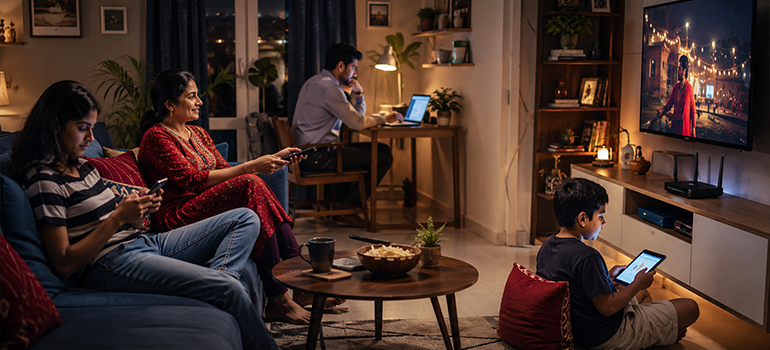
In today’s digital world, a reliable and high-speed internet connection is essential and not just a luxury. Whether for remote work, online games, managing a business, streaming movies, or attending online classes, a broadband internet connection plays a crucial role for every online activity.
Most of us are acquainted with the terminology “broadband”. In fact, it has become an integral part of our day-to-day lives regardless of our needs. But now the question is, what does a broadband internet connection actually mean and why has it become a standard to get high speed internet connectivity.
In this blog, let us understand what broadband internet connection is, the various types, the benefits , uses, and tips to choose the best broadband connection for your needs.
Define Broadband Internet?
The meaning of Broadband refers to higher internet connections that transmit huge amounts of data over various technologies, including DSL, cables, satellite, fiber optics, and wireless networks.
The term “broadband” also signifies wide bandwidth, and enables multiple signals and large volumes of data to travel simultaneously. Consequently, this results in better performance, lower latency, and high-speed internet.
In its simplest form, broadband internet is a continuous, high speed internet connection.
Key features
- High speed internet connection
- Supports multiple devices
- Reliable performance
- Fast upload and download speed
- Lower latency
- Suitable for video conferencing and HD video streaming
Types of Broadband Internet
Broadband internet connections can be easily classified based on their transmission technology. Each of the broadband types is preferred considering its speed, capacity, budget, and location.
1. Fiber Optic broadband
Fiber-optic broadband uses thin strands of glass or plastic to transmit data as light signals. It offers the fastest internet speeds, low latency, and high reliability, making it ideal for streaming, gaming, and remote work.
2. DSL broadband
DSL delivers internet services through existing telephone lines. It provides a dedicated connection and is widely available in many residential areas. However, its speed may decrease with distance from the service provider’s facility.
3. Cable broadband
Cable broadband uses the same coaxial cables that deliver cable television services. It offers faster speeds than DSL and is suitable for streaming, online gaming, and multiple connected devices.
4. Satellite broadband
Satellite broadband delivers internet connectivity through communication satellites orbiting the Earth. It is available in remote locations but may experience higher latency because the long-distance signals must travel.
5. Fixed Wireless Broadband
Fixed wireless broadband transmits internet signals through radio waves between a nearby tower and a receiver installed at the user’s location. It is commonly used in rural and remote areas where there is a lack of wired connections.
Uses of Broadband Internet
A broadband internet connection has become a quite essential aspect of our daily life.
Here are a few key uses of a broadband internet connection:
1. Online Education
Back to the times when students used broadband connections for attending virtual classes. Today, they use it for various purposes, such as completing assignments, participating in live lectures, and accessing learning platforms.
2. Remote Work
Working professionals, especially corporate employees, rely on broadband internet connections for various purposes, which include:
- Video meetings
- Project collaboration
- Cloud storage
- File sharing, and more
3. Entertainment
Apart from education and remote work, entertainment is the major area where broadband is used. This includes:
- Streaming video
- Live sports
- Online gaming
- Music streaming
- HD streaming
4. Smart Homes
Now-a-days, smart devices have become increasingly popular and depend on stable internet connectivity.
- Smart devices include:
- Smart lights
- Smart TVs
- CCTV cameras
- Voice assistants, and others
5. Healthcare
Broadband internet connection plays a vital role in healthcare domain activities, including:
- Telemedicine
- Remote patient monitoring
- Online consultations
- Electronic media records
6. Digital Banking
In the banking sector, broadband connection facilitates secure and convenient online financial services. Today, users can access banking services anytime, anywhere, without visiting a physical branch.
Key uses of broadband internet connection in digital banking, include:
- Online fund transfers
- Internet banking
- Mobile banking
- Credit card applications
- Digital wallet
- UPI transaction
- And, more
7. Online Shopping
Broadband internet connection has made online shopping simpler and more convenient than ever before. Customers can browse, compare, and buy products as per their convenience through various e-commerce platforms.
8. Business Operations
In modern day business operations, a broadband internet connection enables communication and collaboration amongst the team and access to digital tools. Moreover, businesses rely on high-speed internet connections to streamline processes, improve business productivity, and serve customers effectively.
Key uses of broadband connections in businesses, include:
- Inventory and supply management
- Online transactions
- Virtual meetings
- Email communication
- Video conferencing, and more
Broadband internet connection continues to drive innovation across diverse sectors, thereby making day-to-day tasks more efficient, convenient, and helping to stay connected.
How Does the Broadband Internet Work?
Broadband internet connections work by transmitting large amounts of data at high speeds using technologies, including DSL, fixed wireless networks, satellite systems, and fiber optic cables.
Here is how broadband internet works:
1. Internet Service Provider
Your internet service provider (ISP) provides internet connectivity through several options available. The ISP acts as a gateway between the Internet and the users.
2. Data Transmission
When a user requests a webpage/audio/video, the ISP sends digital data packets via its network at a higher speed.
3. Modem
A modem converts incoming internet signals from the ISP into the format that your local internet network can understand.
4. Router
The router distributes internet connection through Wi-Fi or wired connections to multiple devices connected to it and allows users to access the internet simultaneously.
5. Connected Devices
Ultimately, devices, such as smartphones, laptops, smart devices, and phones receive internet access immediately and enable them to perform various digital activities.
Conclusion
Broadband internet connection has truly transformed the way people work, learn, communicate, and enjoy entertainment. The always-on high-speed internet connectivity supports a wide range of day-to-day activities, including online education, smart home devices, video conferencing, and much more. With the availability of several technologies, such as fiber optic cable, satellite, fixed wireless, and DSL, there are diverse options to choose from that suit your location, internet usage, and budget. Each type offers unique pros and cons, thereby making broadband accessible to diverse users.
As the demand for high speed and reliable internet connectivity continues to grow, broadband connections will remain a foundation in today’s digital age. By understanding how broadband actually works, its types, and its uses, you can make informed decisions when choosing the best internet connection for your needs.


