
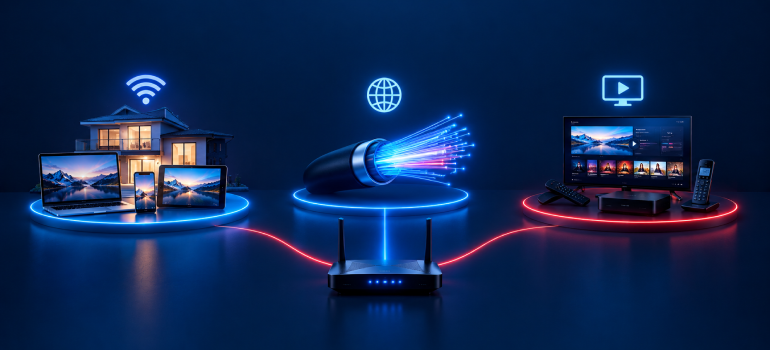
When choosing an internet connection for your home or office, you may come across terms such as fibre broadband, DSL and cable internet. All three provide internet access, but they use different technologies to deliver it.
The three different types of broadband internet services discussed here are fibre-optic broadband, Digital Subscriber Line (DSL) and cable broadband.
Each has its own advantages, limitations and installation requirements. Understanding these differences can help you compare available services and choose a connection that suits your needs.
What Is Broadband Internet?
Broadband refers to internet connectivity that supports the transmission of data for activities such as browsing websites, streaming videos, attending online meetings and downloading files.
Unlike traditional dial-up internet, broadband connections generally remain available without requiring users to establish a new dial-up connection for each session.
Broadband can be delivered through different technologies, including optical fibre, copper telephone lines, coaxial cables and wireless networks.
The technology used to deliver the connection can influence its capacity, performance and installation requirements.
However, the broadband technology alone does not determine the quality of the service. Network conditions, equipment and the subscribed plan also matter.
What Are the Three Different Types of Broadband Internet Services?
Three established wired broadband technologies are fibre-optic, DSL and cable internet.
The main difference is the type of infrastructure used to transmit data.
1. Fibre-Optic Broadband
Fibre-optic broadband uses thin strands of glass or plastic to transmit data through pulses of light.
Optical fibre can carry large amounts of information over considerable distances, making it suitable for high-capacity internet networks.
One common arrangement is Fibre to the Home (FTTH), where optical fibre extends directly to the subscriber’s premises.
Other arrangements may use fibre for part of the connection and another technology for the remaining distance.
How Does Fibre Broadband Work?
An internet service provider delivers data through its fibre network.
At the subscriber’s premises, an optical network terminal (ONT) or compatible equipment converts optical signals into data that connected devices can use.
A router can then distribute the internet connection through Ethernet cables or Wi-Fi.
Advantages of Fibre Broadband
High capacity: Fibre technology supports high data rates and can accommodate demanding internet activities.
Suitable for multiple devices: A connection with sufficient subscribed bandwidth can support simultaneous streaming, video meetings and downloads.
Upload capability: Fibre networks can support substantial upload speeds, which can be useful for cloud backups and large file transfers.
Resistance to electromagnetic interference: Optical fibre is not affected by electromagnetic interference in the same way as copper communication cables.
Limitations of Fibre Broadband
Fibre availability depends on the infrastructure installed in a particular area.
A new connection may require additional cabling, equipment or installation work.
Actual download and upload speeds depend on the service offered by the provider and the capabilities of the equipment.
Who May Benefit From Fibre Broadband?
Fibre can be a suitable option for households with several connected devices, remote workers, content creators and small businesses that regularly transfer large files.
It is particularly worth considering when higher bandwidth requirements are expected to increase over time.
2. DSL Broadband
DSL stands for Digital Subscriber Line. It delivers internet connectivity through copper telephone lines.
DSL technology allows data to travel over telephone infrastructure that may already be installed in homes and offices.
There are different types of DSL, including ADSL and VDSL.
ADSL typically provides higher download speeds than upload speeds, while VDSL can support higher data rates over suitable shorter copper connections.
How Does DSL Broadband Work?
DSL uses the copper line connecting the subscriber’s premises to the provider’s network equipment.
A DSL modem receives and transmits internet data through this line.
The connection can then be shared with other devices using a router.
DSL performance depends on factors such as copper line quality, the technology used and the distance to the relevant network equipment.
Advantages of DSL Broadband
Existing infrastructure: DSL may use telephone wiring that is already present.
Basic internet access: Where suitable service is available, DSL can support activities such as email, browsing and everyday online communication.
Limited installation changes: Some connections may require less new cabling than a completely new wired network installation.
Limitations of DSL Broadband
DSL performance can decline as the copper line becomes longer.
Older or damaged wiring may also affect connection quality.
Compared with modern fibre systems, many DSL connections have lower capacity, particularly for uploading large files.
The actual limitations depend on the DSL technology and local network conditions.
Who May Benefit From DSL Broadband?
DSL may be useful where copper telephone infrastructure is available but fibre or cable broadband services are not.
It can be suitable for users whose requirements are modest and whose available DSL connection provides sufficient performance.
Before subscribing, check the speeds that can realistically be delivered at the specific address.
3. Cable Broadband
Cable broadband delivers internet connectivity through coaxial cable infrastructure commonly associated with cable television networks.
Many cable broadband systems use a combination of optical fibre and coaxial cable, known as a hybrid fibre-coaxial (HFC) network.
Cable internet commonly uses technologies based on the Data Over Cable Service Interface Specification (DOCSIS).
How Does Cable Broadband Work?
The provider’s network carries internet traffic through its cable infrastructure.
At the subscriber’s premises, a cable modem communicates with the provider’s equipment over the coaxial connection.
The modem may connect to a separate router or be integrated with routing and Wi-Fi functions.
This allows multiple devices to access the internet through the same broadband service.
Advantages of Cable Broadband
High download capacity: Modern cable networks can support substantial download speeds.
Existing cable infrastructure: Where compatible cable networks are already installed, providers may be able to use that infrastructure for broadband access.
Suitable for entertainment: With sufficient available bandwidth, cable broadband can support video streaming, browsing and gaming.
Limitations of Cable Broadband
Cable network capacity may be shared among subscribers within a local network segment.
During periods of heavy demand, congestion can affect performance if sufficient capacity is not available.
Upload speeds may also be lower than download speeds, depending on the network technology and service configuration.
Cable broadband availability depends on the local provider’s infrastructure.
Who May Benefit From Cable Broadband?
Cable broadband can be suitable for households that frequently stream videos, use several connected devices or require substantial download capacity.
It may also support small business activities when the available upload speeds and service conditions meet the organisation’s requirements.
Fibre vs DSL vs Cable Broadband: Key Differences
The following comparison highlights the main differences between these broadband technologies.
| Feature | Fibre Broadband | DSL Broadband | Cable Broadband |
| Transmission medium | Optical fibre | Copper telephone lines | Coaxial cable, often combined with fibre |
| Main technology | Optical communication | Digital Subscriber Line | Cable modem technologies such as DOCSIS |
| Speed potential | Very high | Depends strongly on DSL type and line conditions | High with suitable modern infrastructure |
| Upload capacity | Can support high upload rates | Often lower, depending on DSL type | Depends on network configuration |
| Distance limitations | Less affected by distance than DSL | Copper line length can significantly affect speed | Depends on cable network design |
| Main infrastructure requirement | Fibre network | Suitable telephone wiring | Compatible cable network |
| Typical equipment | ONT and router | DSL modem and router | Cable modem and router |
| Availability | Depends on fibre deployment | Depends on compatible copper infrastructure | Depends on local cable infrastructure |
These differences describe the technologies rather than guaranteeing the performance of individual services.
For example, a fibre connection does not automatically provide symmetrical upload and download speeds. That depends on the subscribed service.
Similarly, cable broadband does not necessarily perform poorly during busy hours. Congestion depends on how the provider manages network capacity.
Which Type of Broadband Is Suitable for Your Needs?
The right broadband connection depends on what you do online and which technologies are available at your address.
For Everyday Browsing and Email
Users who mainly browse websites, send emails, and access basic online services may find a suitable DSL, cable, or fibre connection sufficient.
The subscribed speed and connection reliability are more important than choosing a technology based on its name alone.
For Streaming and Online Entertainment
Streaming requires sufficient download bandwidth and a stable connection.
Fibre and cable broadband can both support demanding entertainment activities when the service provides adequate capacity.
DSL may also support streaming, depending on the available speed and video quality.
For Remote Work
Video conferencing, cloud applications and file transfers require reliable connectivity.
Upload speed becomes particularly important when sending large files or participating in simultaneous video meetings.
A fibre connection with suitable upload capacity may be beneficial, but other technologies can also support remote work effectively.
For Small Businesses
Small businesses should consider the number of employees, cloud applications, online meetings and file transfer requirements.
The best connection is one that provides adequate upload and download capacity, suitable reliability and appropriate support arrangements.
What Should You Consider Before Choosing Broadband?
Before selecting a broadband service, compare the practical requirements of your household or business.
1. Availability
Confirm which technologies and providers serve your exact location.
2. Download and Upload Speeds
Download speed affects receiving data, while upload speed affects sending information.
Both matter when evaluating a connection.
3. Reliability
Ask about the service’s expected performance and any applicable support or service commitments.
4. Equipment
Check whether the installation requires an ONT, DSL modem, cable modem or additional router.
5. Usage Requirements
Consider simultaneous users, streaming quality, online meetings and large file transfers.
6. Total Cost
Compare recurring charges, installation fees, equipment costs and applicable service terms.
Understanding the difference between broadband and mobile internet can also help when deciding between a fixed home connection and a portable alternative.
Are There Other Types of Broadband Connections?
Yes. Fibre, DSL and cable are three established wired broadband technologies, but they are not the only broadband options.
Other types include fixed wireless broadband, mobile broadband and satellite internet.
Fixed wireless uses radio signals to connect a specific location to a provider’s network.
Mobile broadband uses cellular networks, including 4G and 5G, to provide internet access through compatible devices.
Satellite broadband uses satellite communication systems and can be useful where terrestrial infrastructure is limited.
Their availability, performance and equipment requirements vary.
Conclusion
The three different types of broadband internet services covered here are fibre-optic, DSL and cable broadband.
Fibre uses light signals through optical cables, DSL uses copper telephone lines, and cable broadband uses coaxial infrastructure.
Each technology has different capabilities and installation requirements.
Before choosing a connection, compare local availability, download and upload speeds, reliability, equipment and service terms.
The most suitable broadband connection is the one that meets your everyday internet requirements at your specific location.


