
Introduction
The internet has become an essential part of our day-to-day lives, from online classes to OTT streaming, remote work, and enabling smart home devices. In this context, having a broadband connection has become a mere necessity rather than a luxury. Behind every reliable internet connection, there is an invisible system known as the “Internet Protocol” that enables communication between devices. Without an IP address, the internet world wouldn’t function as data will not have any specific address to move ahead.
Since the inception of the IP address, it has evolved significantly. IPv4 has been the most widely used version and standard for decades. However, with the rising number of devices connecting to the internet, the IPv4 limitations has become apparent. And this led to the development of IPv6, which is steadily gaining prominence.
In this blog, let us explore the difference between IPv6 and IPv4 and what it actually means for your home broadband connection.
Understanding IPv4
Internet Protocol Version 4 or IPv4, is widely known as the fourth version of the Internet Protocol. It is a 32-bit long address system and composed of 4 octets, which is written in decimal digits between 0-255. With technological advancements, there is an explosive growth of smartphones, IoT devices, laptops, smart TVs, and broadband users globally led to the shortage of IPv4 addresses.
Key features
- Easy to configure with traditional internet networks
- Uses 32-bit addressing
- Supports 4.3 billion addresses
- Compatible with older devices/websites
- Depends on Network Address Translation (NAT)
Example of IPv4 address: 192.168.1.1
- The first 3 octets represent- Network
- The last octet represents- A specific device
Understanding IPv6
IPv6 is basically designed to overcome the IP address shortage issues with IPv4. It is a 12-bit address space, encompassing a vast pool of unique IP addresses. Implementing IPv6 is specifically important for businesses that rely on the internet for diverse tasks, such as cloud providers, IoT device manufacturers, and content delivery networks. However, these organizations must ensure that their network connection and devices are compatible with IPv6. Additionally, it provides significantly better security compared to IPv4, making it crucial for businesses to handle organization’s sensitive data.
Key features
- Provides trillions of unique IP addresses
- Uses 128-bit addressing
- Enhanced security features
- Better routing efficiency
- Designed focusing on modern internet infrastructure
Example of an IPv6 Address
2001:0db8:85a3:0000:0000:8a2e: 0370:7334
Thus, IPv6 represents the future of internet connection and is critical for businesses that rely on the internet. It is gradually being adopted in India and worldwide for its vast IP address space and exceptional features, such as efficiency and security, facilitating the growth of the internet.
Difference Between IPv6 and IPv4
| Features | IPv4 | IPv6 |
| Address format | 32-bit numeric | 128-bit alphanumeric |
| Address capacity | 4.3 billion address capacity | Virtually unlimited |
| Header size | 20 bytes | 40 bytes |
| Speed and efficiency | Slow routing | Fast and efficient |
| Security | IPsec support available- optional | IPsec support- mandatory |
| Configuration | Manual/DHCP | Automatic configuration |
| Compatibility | Designed mainly for IPv4 networks | Compatible with the modern systems, but it requires tunnelling for backward compatibility |
| Performance | Less optimal |
|
| NAT compatibility | Necessary | Unnecessary due to a wider pool of IP addresses |
The most significant difference one could ever witness is the number of addresses available in IPv6, as it ensures the internet can grow significantly without actually running out of IP addresses.
How IPv4 Affects Your Home Broadband Connection?
The impact of IPv4 on your home broadband connection is significant in several ways:
- The internet service providers share one public IPv4 address amongst several users using NAT (Network Address Translation).
- The limited IPv4 address capacity makes it more complex to handle network management.
- NAT, at times, creates problems especially for online gaming, remote desktop access, video conferencing, and port forwarding.
How IPv6 Affects Your Home Broadband Connection?
Many internet users wonder whether IPv6 enhances internet performance, but in reality, switching to IPv6 may not increase internet speed instantly, but it offers several benefits too.
Here are a few to mention:
1. Better Device Connectivity
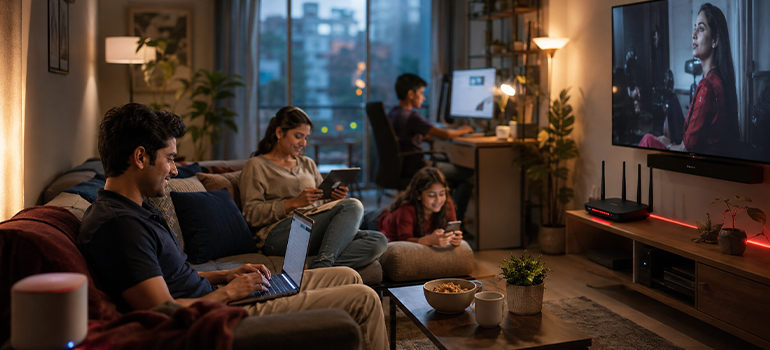
Now-a-days, we could witness that most houses are often connected to multiple devices, including:
- Laptops
- CCTV camera
- IoT appliances
- Smart TVs
- Smartphones
- Gaming consoles
The presence of IPv6 provides sufficient addresses for every device that is connected without actually depending on NAT. This facilitates smoother communication between several devices and enhances network efficiency.
2. Improved Speed
Some IPv6 users experience:
- Faster loading
- Lower latency
- Better connection
- Improved routing
3. Improved Security
IPv6 supports in-built IPsec, which is a protocol mainly designed to secure internet communications. Though security majorly depends on device configuration and ISP, but IPv6 provides a stronger foundation for encrypted communication.
4. Better Streaming
OTT streaming services increasingly support IPv6. And, the routing sometimes can provide direct and efficient pathways to enhance streaming capability.
What is NAT? How IPv6 Reduces the Need for NAT?
Network Address Translation (NAT) is basically a networking technique used by routers to modify IP addresses, while the data packets are still in transit. It enables multiple devices within a local network to share a single IP address while connecting to a network.
NAT technique is commonly used in IPv4 networks because of the limited availability of IP addresses.
Example: At home, your Wi-Fi may be connected to:
- Phone
- Laptop
- Smart TV
In this scenario, all the devices are using IPv4 network, which means connected to a single, public IP address. Therefore, using NAT becomes mandatory in this context.
However, transitioning to IPv6 provides sufficient and unique IP address for every device connected to the internet, thereby reducing the necessity for NAT.
Overall, this creates a more efficient and simplified internet architecture.
Is it Necessary to switch to IPv6?
If your router and internet service provider support IPv6, then there is no need to switch manually to IPv6, it will be enabled automatically.
However, you can still consider switching to IPv6, if:
- You are using smart home devices.
- You are interested in online games.
- Your router supports dual-stack networking.
Ultimately, enabling IPv6 is beneficial and safe for most households.
Conclusion
IPv4 and IPv6 are the robust building blocks of internet communication, but IPv6 represents the future of digital connectivity. While IPv4 is confined to its address space and can’t handle the growing number of devices connected globally. In contrast, IPv6 solves the issues with IPv4, by offering virtually unlimited IP addresses, with improved efficiency, security, and better scalability.
Indian ISPs focus on continually expanding IPv6 deployment and users can continually expect more reliable internet services in the upcoming years. However, the transition to IPv6 is happening gradually and shapes the future of Indian broadband connectivity.
Irrespective of your internet requirements, understanding the difference between IPv4 and IPv6 will help you make smarter decisions about your internet installation.


